System Gods
Systema Delenda EstSystem-gods, also called World Deities, form the divine administrative layer of the System. They govern planets through interfaces, planetary administrators, quests, portals, essence budgets, and delegated mortal institutions, while the clans organize much of their political power. Their decisive significance lies in the contradiction at the center of their rule: they are powerful enough to manage thousands of worlds and reshape planetary priorities, yet dependent on the System’s infrastructure and vulnerable to disruptions they cannot immediately understand. Cato exposes that weakness by attacking not merely individual gods but the feedback mechanisms, resource flows, and assumptions that make their vast order appear stable.
Nature and Administrative Power
System-gods exercise authority through the System rather than through constant physical presence. Their interfaces manage the many simultaneous demands of planetary administration, while the System translates decisions into quests, restrictions, rewards, and notifications. Onswa’s experience shows how abruptly that authority can vanish: while trying to spend the remaining essence reserves on special and explanatory quests, he received notices that interplanetary travel restrictions had been lifted and his Planetary Administrator privileges suspended. The divine-administrative order therefore depends on permissions that can be withdrawn as quickly as they are granted.
Essence is the central resource of this system. Fighting and clearing dungeons creates essence, which is divided among participants, rewards, and planetary reserves; those reserves fund cities, towns, dungeons, and special quests, including advancement and defense quests. System-gods can use essence directly in ways mortals cannot, turning planetary production into personal privilege. Marus, living in luxurious quarters inside his System Space, had purchased those comforts with essence siphoned from Sydea’s churn. He also intended to empty Sydea of its native population and later return the accumulated reserves to accelerate the growth of the Eln Clan’s favored races. Divine administration thus combines public infrastructure with private extraction, making the prosperity of a world inseparable from the interests of the god who controls it.
Fragmented Divine Government
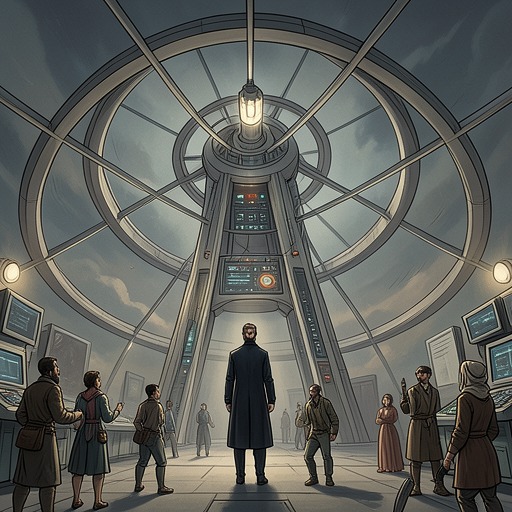
The System-gods are a ruling class rather than a harmonious council. Their worlds are gathered under powerful clans, but clan interests routinely compete, and many gods remain outside the Nine Great Clans. Cato’s simultaneous assault on forty worlds forces Clan Eln and Clan Lundt into an unprecedented joint crisis. Their gods, many of whom had not seen one another for centuries, crowd together in Clan Lundt System Space, arguing while scry windows display worlds under attack. The scale of the assault is alarming even though the clans control thousands of worlds: losing roughly twenty worlds apiece is proportionally small, but it is unprecedented within their ordinary pattern of rivalry, betrayal, and limited annexation.
This fragmentation also creates a sharp inequality between powerful clans and independent gods. Misse identifies the independent polities of the Inner Worlds and nearby frontier as especially vulnerable because they cannot be trusted to follow what the Core considers necessary. Her proposed response is gradual pressure: approach each independent world separately and in stages, preventing the threatened gods from forming a unified response. The policy reveals that the System-gods’ emergency measures are directed not only against Cato but also against political autonomy. Cato’s invasion becomes the justification for bringing unaffiliated worlds under clan control.
Their lack of preparation is another consequence of inherited authority. Initik observes that many clan gods were raised within powerful clans, granted World Deity status, and trained to administer worlds without ever having to rise from mortal weakness through personal struggle. When confronted by Cato’s first genuinely large-scale threat, they are bewildered and dependent on collective deliberation. Their privilege has produced administrative competence without corresponding experience in direct danger.
Response to Cato
The System-gods initially misread Cato’s campaign because their information arrives through delayed, partial, and uneven channels. On different worlds, higher-rankers receive more urgent defensive quests, and their movement reveals a preferential emergency response. Yet the gods do not share a complete picture. Marus’s interface assures him that Sydea’s strange defense quest involves no major loss beyond a dungeon, allowing him to interpret the disruption as useful budget reduction rather than as the beginning of planetary collapse. His confidence depends on the System’s own incomplete diagnosis.
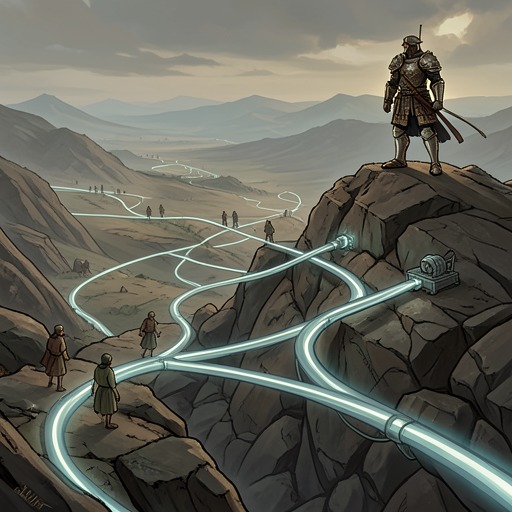
Cato’s industrial strategy magnifies that delay. His expansion reaches hundreds of worlds, each equipped with factories, mines, refineries, atmospheric extraction, volatile processing, and vast solar-panel production. Because portals cannot move forces effectively, each world manufactures its own armies and combat frames. A small fraction of each industrial base is devoted to weapons, while another portion can be rapidly converted between production and war. The System-gods face not a single army but a distributed manufacturing ecology whose capacity grows while they are still deciding where the threat is located.
The first divine countermeasures show both the gods’ power and their limits. Native Bismuths on Rhurel, Koes, and Khem defend their worlds with vortices, earth domes, and hypersonic wire attacks, but one or two high-rankers cannot cover an entire planet. Lakor eventually abandons remote administration and invokes Manifest on Koh-rel. He appears as a colossal titan above the capital city Nexus and tears a mountain from the ground, displaying force capable of continent-level destruction. Yet that spectacle is strategically inadequate against Cato’s distributed presence, and Lakor is killed. The event teaches the divine coalition that ordinary displays of rank and direct combat cannot reliably answer a threat operating through innumerable industrial nodes.
The response then becomes institutional and coercive. The clans invoke a Crusade and consider imposing minimum portal thresholds, a measure that would cripple Cato because his creatures are only Copper rank. Misse authorizes divine gifts for Crusader Muar so that Azoth-rank and higher agents can fight beyond worlds, using small Nexus crystals set into chains to project System authority into otherwise inaccessible battlefields. The same emergency framework is used against independent gods, whose worlds are treated as politically suspect even when they have not openly declared for Cato.
Resource War and Emergency Sovereignty
The deepest damage inflicted by Cato is not always visible as conquest. Misse eventually recognizes that his invasions are designed to drain the System’s reserves. He avoids unnecessary aggression, opens wounds in infrastructure, and then remains quiet enough to prevent immediate, obvious devastation. The System responds by pouring essence into damaged worlds to offset the destruction, creating an enormous and largely hidden cost. With True Deity authority, Misse sees that the reserve loss is so severe that maintaining those worlds may cost more than their value.
Misse therefore severs the affected worlds herself, stopping the flow of essence and abandoning fringe territories to prevent further depletion. She presents the act as protection from a corruption the gods did not realize was present, while also warning that Cato has demonstrated the ability to kill deities. This is emergency sovereignty in its starkest form: the right to preserve the whole is expressed through unilateral decisions about which worlds may be cut away. The measure protects the System’s remaining resources, but it also confirms that the gods’ response to crisis is inseparable from hierarchy, sacrifice, and the removal of local choice.
The confrontation with Cato makes the political contradiction explicit. Misse attributes the absorption of Mishkell and the collapse of the frontier to Cato’s hostility, while Cato rejects the claim that his quarrel is with her personally and identifies the System itself as his enemy. The exchange separates the gods from the structure they administer only rhetorically; in practice, defending the System requires them to defend their own authority, privileges, and access to essence.
Crisis at the Core
The System-gods’ access to the deepest levels of power is itself stratified. Keppel Eln meditates in the outer vestibule of the True Core alongside divine figures from other clans, where combat Skills are forbidden by both custom and the System’s own declaration. Only a limited subset of beings with divine affinity may approach closely enough to commune with the System’s heart. The True Core is described as an enormous globe-spanning cradle joining detached System Spaces to the most essence-rich world in existence; proximity determines access to essence and to the System’s inner workings. Even senior gods remain separated from the oldest and most powerful divines who have stood upon the World Of The True Core.
At the final crisis, Misse and Muar attempt to restrict the System’s influence around the War Worlds. The System warns that the action requires additional authorization, which Misse supplies, and then withdraws toward the True Core while essence drain stops and the Font provides power. The apparent success is immediately overturned. Physics resumes around the War Worlds, where a hundred suns are suddenly close enough for gravity to act, and the System forcibly relocates Misse and Muar into fast-time at the Font. Scry views of the Core show only furious white, while essence totals fall rapidly. Misse responds by ordering that everything possible be pruned, demonstrating that the System-gods have moved from administration to triage.
Their final position is therefore paradoxical. They command planetary resources, mobilize clans, manipulate quests, manifest in colossal forms, and can sever worlds from the infrastructure that sustains them. Yet they remain intermediaries within a larger machine, dependent on its permissions and unable to see the full consequences of its operation until collapse is already underway. Cato’s campaign turns that hidden dependency into a visible political disaster: the gods’ immense authority cannot prevent the System from becoming the battlefield, the resource pool, and ultimately the object of destruction.